| BABIES CPR
by Dave Burns
As some of you may have noticed, Babies are not built to the same
specifications as adults and children. To begin with, they are a
lot softer, and they seem to have no necks! This makes the ABC of
resuscitation slightly different.
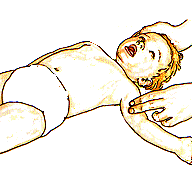 To
begin with, lay the infant on a hard surface that is within your
reach. The floor is a long way down. Use a table, or sideboard.
Open the airway by tilting the head very slightly back, not as far
as you would with an adult. Check the breathing in the normal way,
but be aware that a baby breathes faster than an adult or child,
and you may not see chest movement. To
begin with, lay the infant on a hard surface that is within your
reach. The floor is a long way down. Use a table, or sideboard.
Open the airway by tilting the head very slightly back, not as far
as you would with an adult. Check the breathing in the normal way,
but be aware that a baby breathes faster than an adult or child,
and you may not see chest movement.
Hopefully the baby is breathing, if so, instead of laying them
down in the recovery position as you would for an adult or child,
Pick them up and hold them, with the head slightly lower than the
rest of the body, and the back to your chest.
 If
there is no breathing present, you need to give some air. Cover
both nose and mouth with your mouth and give a small puff. (Imagine
blowing out a candle). Do this 5 times, not 2 as with adults. Now
check for signs of pulse. If
there is no breathing present, you need to give some air. Cover
both nose and mouth with your mouth and give a small puff. (Imagine
blowing out a candle). Do this 5 times, not 2 as with adults. Now
check for signs of pulse.
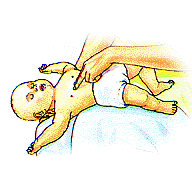
Being smaller and softer, using the pulse in the neck can do damage
to a baby, Therefore we check the pulse in the upper arm. Place
the flat of 3 fingers on the inside of the upper arm, and the thumb
on the outside. Using a light pressure you should then feel the
brachial pulse. Is there a pulse present? Is it more than 60 per
min? If yes, carry on giving air and get help fast. If the pulse
is less than 60, assume no pulse and give chest compressions. Again,
there is a difference here. First, the pressure point is about one
finger below the nipple line. Just use 2 fingers, and depress the
chest about 1/3rd of the chest depth five times then give one breath
and continue at 5 compressions to one breath. (This must be on a
firm surface or the pressure will not go where needed). The chances
of resuscitating a baby successfully are higher than that of an
adult, if you do not panic!
For more information, Call your local Red Cross and ask about training.
You will be surprised at how cheap and easy it is to learn how to
save lives.
DISCLAIMER:
First aid is not a subject that can be learned from books or articles.
To become a true first aider you need to undertake proper training
that will give you the opportunity to practice in a safe and controlled
environment. Neither I as the author or the World Wide Information
Outlet can or will be held responsible for anything that happens
as a result of this article. Having said that, when a life is at
stake, you should at least try. Under the 'good samaritan' law,
provided your intention was to do good, nobody can touch you for
it!
Brought to you by: World Wide Information Outlet - http://certificate.net/wwio/,
your source of FREEWare Content online.
Dave Burns is a Trainer with the British Red Cross. He is currently
based at Shrewsbury, Shropshire in the UK and has been training
now for 7 years.
Most of the time is fun, but as any trainer will tell you, it all
depends on your class. There is always one that knows it all, and
one who just cannot grasp what you are saying.
I think that a trainer always needs to keep on top of what is happening,
and adapt their courses to the students needs. It is also good to
meet and chat to other trainers to get new ideas and perspectives.
This is the reason for this area.
Your ideas and comments would be most welcome.
Email me at dave@burns.enta.net or visit http://www.burns.enta.net
|